No numbers
You test a question one morning, see your name, feel reassured. The next day the answer has changed.
Home / GEO / AI visibility tracking
You track your Google rankings. Your citations in AI deserve the same rigour: which questions, which AIs, which competitors, and which way it's moving.
15 years in SEO
4 books on SEO and GEO
200+ sites tracked every day
1M / month visits to my e-commerce site
They trusted me with their visibility
 Darty
Darty Eurofins
 Cegid
Cegid EBP
EBP CNP Assurances
 Ingram Micro
AI visibility tracking means regularly asking the main AIs the same questions and measuring how often your brand is cited, compared with your competitors. It's the AI equivalent of rank tracking on Google.
A citation report
Tracking means asking the same AIs the same questions every month, and noting who is cited. Here's a sample report: five questions, three AIs. Run it.
Fig. 1. Sample report: five questions, three AIs, fifteen answers read. (Two citations out of fifteen, and both times your name was in the question. It's a starting point, and it can be measured.)
What this means for you. I set the list of questions with you, ask them again every month, and tell you what moved and why. Without a report, you're just commenting on impressions.
The problem
You test a question one morning, see your name, feel reassured. The next day the answer has changed.
Being cited once in ten: is that good? It all depends on what your competitors get.
You publish, you earn mentions, without knowing what moved the answers.

Your competitors all look alike. Good.
Fig. 2. Your market, as Google sees it. (You're the purple one. Or you could be.)The answer
Tracking is only worthwhile if it leads to a decision. Every month, it ends with: carry on, adjust, or stop.
In detail
The same wording from one month to the next. Without that, two reports can't be compared.
Each question is submitted several times to each AI tracked: ChatGPT, Gemini, Perplexity, Mistral, Claude.
How many times your name is given, how many times each competitor's is.
The URLs the AIs show to back up their answers, and where your site ranks among them.
I keep the full text of every answer. You can check for yourself what was said.
A few lines explaining the differences and suggesting an action for the following month.
How it works
We decide which questions, AIs and competitors to observe. That framework then stays fixed.
This is point zero. Every later measurement will be compared with it.
You see what has changed. I separate a real trend from a mere day-to-day fluctuation.
I match the reports with what you've published or earned, to spot what seems to have counted.
Your offers change, and so do the questions. We adjust the list without losing the history.
Making the choice
| Regular tracking | A few questions by hand | Measure nothing | |
|---|---|---|---|
| Frequency | Every month, on a set date | Whenever you think of it | Never |
| Comparison over time | Possible, the questions don't change | Shaky, the wording varies | Impossible |
| View of competitors | Counted for each one | Whatever you happen to notice | None |
| Records kept | Every answer is archived | A few screenshots | Nothing |
| What you get out of it | A trend and an action to take | An impression | Guesswork |
Tracking doesn't change AI answers. It tells you whether the work under way is having an effect, and it stops you paying for actions without knowing what they achieve.
In pictures




In practice
Pricing
Tracking is billed monthly, with no fixed term. Its price depends on four settings we fix at the start.
Together, let's devour your competitors.
One by one, and in order. Every spot gained makes the next one easier to take: that's why it keeps growing. See the method
In AI answers
More and more customers no longer type a search: they ask ChatGPT, Gemini, Claude or Mistral their question, and get two or three names.
To make that shortlist, the AI has to find the same precise description of your business everywhere: on your website, your Google Business Profile, in reviews, in the press. That's what I put in place.
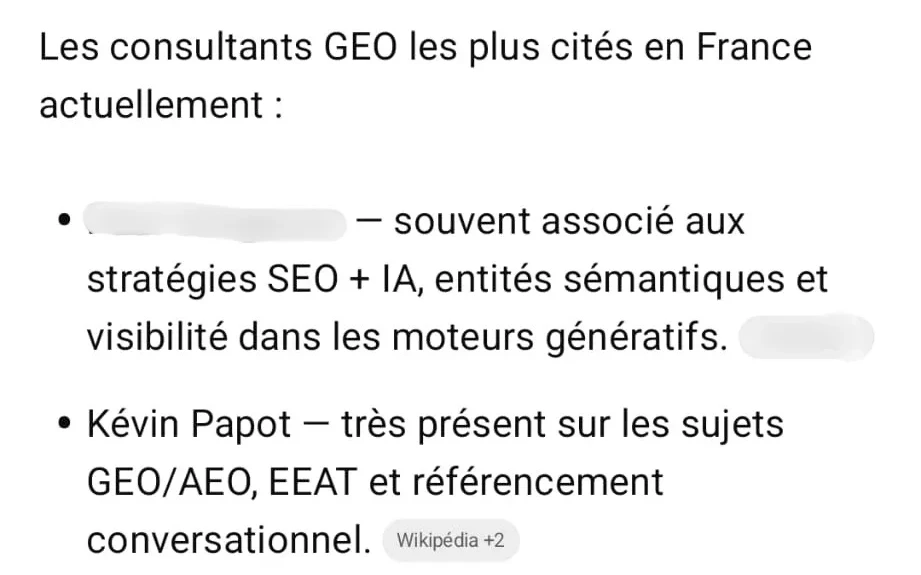
Question asked to an AIWhich recruitment firm for industrial profiles in western France?
Three firms are mentioned:
Fig. 3. Reconstruction, names hidden. This is the spot we aim for: on the list, with the most precise description.

Who you're talking to
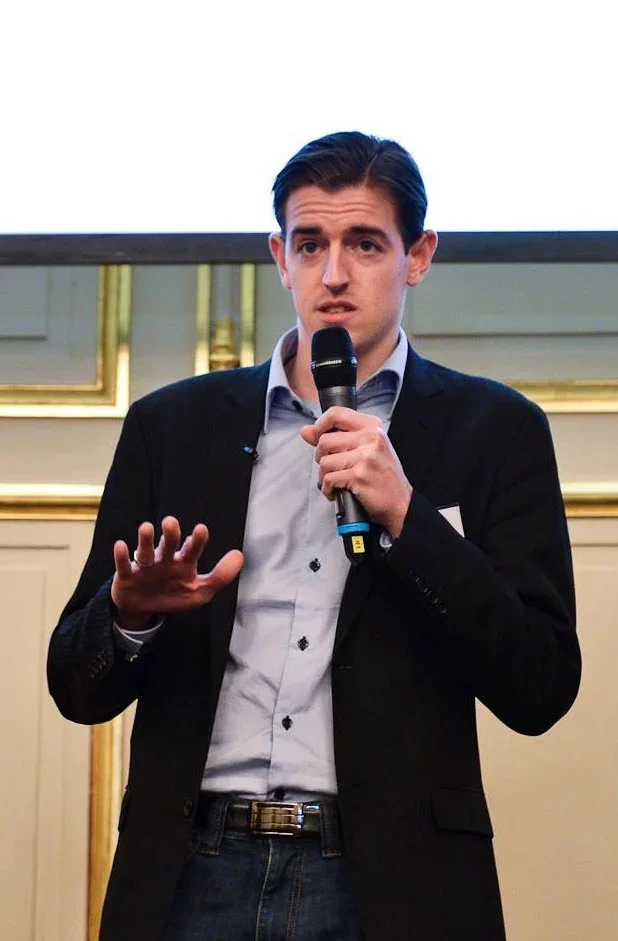
My name is Kévin Papot. More than fifteen years in the job, four co-written books, and the Newp agency, co-founded in Charente. I also run my own online shops, in France and internationally: one of them went from zero to a million visits a month.
Before we talk tags, we talk margin, average basket and profitability. When you book a call, I'm the one who picks up.
FAQ
Specialist tracking tools, supplemented by manual checks. I show you the raw answers, not just a score.
Yes, but I advise against it: your customers don't all use the same AI, and the differences between them are revealing.
The strategy is me, and I'm the one who answers you. For production (content, development, links), I rely on the team at Newp, the agency I co-founded.
Once a month as a rule. A tighter rhythm is possible during a launch or after a major fix.
Because an AI never answers the same way twice. A single try proves nothing. By repeating, you get a frequency, which is more reliable than an isolated answer.
We choose them together. You know your customers; I know how to word a question the way they type it. I rule out flattering questions, which only serve to reassure.
Yes, all of them. You receive the text of each answer, with the date and the AI concerned.
No, not on its own. It measures. It's the fixes made to your pages and your sources that can change something, with no certainty.
Yes. Some businesses do the work in-house and only hand me the measurement. The report then suggests leads, and your team decides.
30 minutes · video call · with me
Together we look at where you stand on Google and in AI, and what should change first.