A half-filled Google Business Profile
Vague category, wrong opening hours, three photos from 2019. Google doesn't promote a listing it doesn't understand.
When someone searches for a plumber, a lawyer or a restaurant, Google shows three listings and a map. Local SEO is all about being one of the three.
15 years in SEO
4 books on SEO and GEO
200+ sites tracked every day
1M / month visits to my e-commerce site
They trusted me with their visibility
 Darty
Darty Eurofins
 Cegid
Cegid EBP
EBP CNP Assurances
 Ingram Micro
Local SEO covers everything that makes you show up when someone searches near them: your Google Business Profile, reviews, the map, and the pages on your website dedicated to your areas. It applies to any business that welcomes customers or travels to them.
The problem
Vague category, wrong opening hours, three photos from 2019. Google doesn't promote a listing it doesn't understand.
Few reviews, old ones, no replies. Your competitors collect new ones every week and overtake you without doing anything else.
No page per town, an address tucked away in the footer. Google doesn't guess your area; you have to spell it out.
The number of listings Google shows next to the map.
(The fourth one exists. Nobody is in a position to confirm it.)

Your competitors all look alike. Good.
Fig. 1. Your market, as Google sees it. (You're the purple one. Or you could be.)The answer
I co-wrote two books on Google Business Profile. The method is public; what counts is applying it all the way.
In detail
I fill it in section by section. I update it when your hours or services change.
A template message, a short link and a set moment to ask. Your team knows what to say.
I write templates for positive reviews and for criticism. You keep your own tone.
A page for each town you serve, with your projects, your lead times and your call-out terms.
I correct your name, address and number on the sites that mention you.
I measure your position street by street, on the words your customers type.
How it works
I record your position on the map, your reviews and those of three nearby competitors.
Categories, services, hours, recent photos. I also get duplicate listings removed.
The request goes out to your recent customers. Every new review gets a reply.
I publish the pages for priority towns and link them to your profile.
Calls, direction requests, position on the map: I send you these three measures and what I'm fixing.
Making the choice
| Profile and website together | Google Business Profile only | Website only | |
|---|---|---|---|
| Where you appear | On the map and in the results | On the map | In the results, below the map |
| What Google learns about you | Your business, your area and your proof | Your address and your category | Your services, with no link to a place |
| Against an active competitor | You have what it takes to respond | You slowly fall back | You stay off the map |
| Work required | Regular, spread over the year | Light | Medium |
| Suits you if | You rely on customers in your area | You're starting out with limited means | You sell everywhere, with no premises open to the public |
The profile decides whether you appear on the map. The website gives Google reasons to put you there. That's why I handle both in the same plan.
In pictures

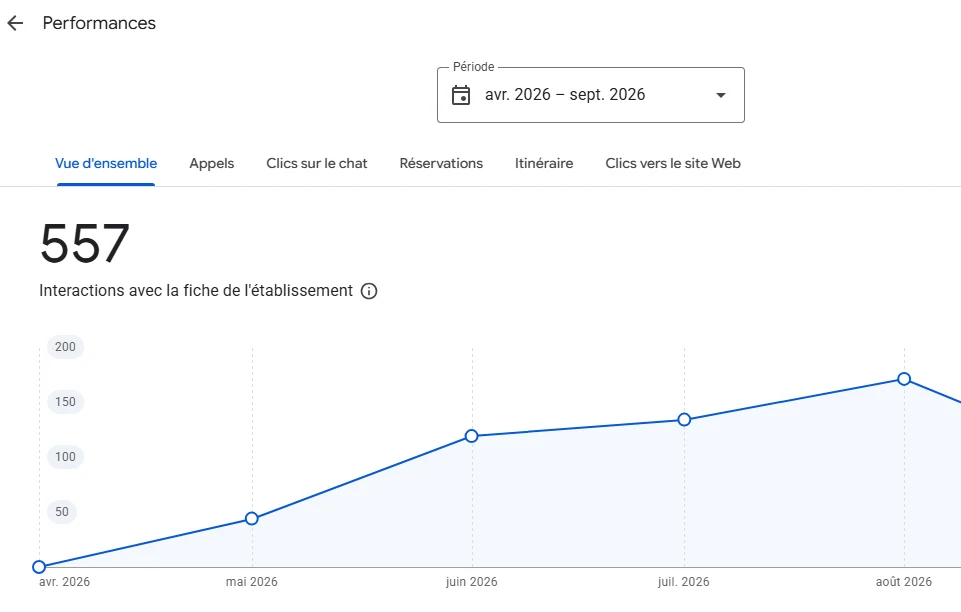
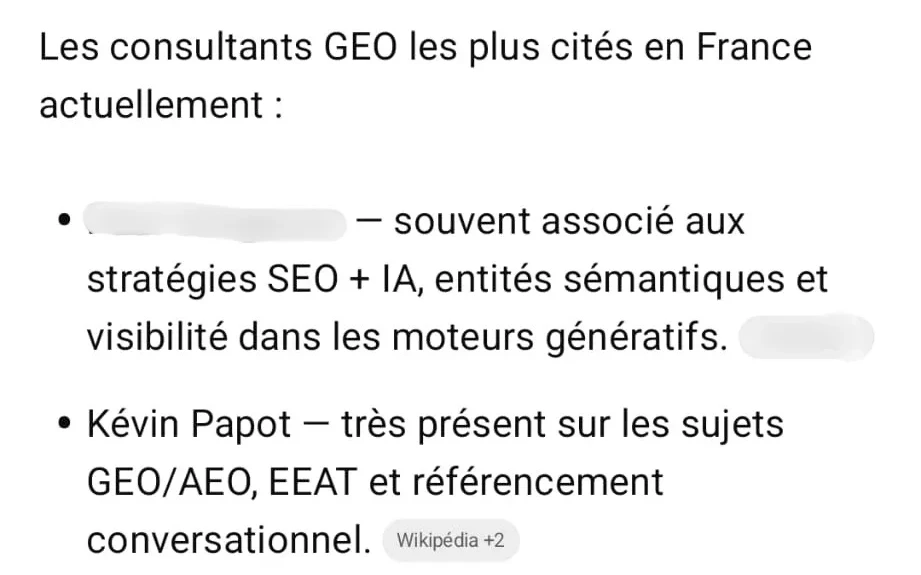




Your turn
Move the sliders with your own numbers. The maths is deliberately simple: searches, a share of clicks, a conversion rate, the value of a customer.
These are your assumptions, not a promise. We swap them for your real numbers during the call.
In practice
Pricing
The amount mainly depends on the number of locations to manage. I give it to you after a free call, once we've looked at your profile and your area together.
Together, let's devour your competitors.
One by one, and in order. Every spot gained makes the next one easier to take: that's why it keeps growing. See the method
One-minute test
Five frank questions to find out whether support makes sense in your situation. Sometimes the answer is no, and I'll tell you.
What it brings in
A ranking doesn't pay a salary. What counts is what it brings: enquiries, customers, revenue. Move your page up and see what it could bring in.
Example assumptions, open to challenge: 800 searches a month for your trade in your town, 4% of visitors make an enquiry, one enquiry in three is signed (this varies a lot from one trade to another), €1,200 per customer. Click-through rates by position are ballpark figures, and they've been shifting since Google started showing AI answers above the results. Redo the maths with your numbers
Possible revenue€0

Who you're talking to
My name is Kévin Papot. More than fifteen years in the job, four co-written books, and the Newp agency, co-founded in Charente. I also run my own online shops, in France and internationally: one of them went from zero to a million visits a month.
Before we talk tags, we talk margin, average basket and profitability. When you book a call, I'm the one who picks up.
FAQ
Each location has its own profile and its own page. We work on a shared template, then adapt it: that's what I do for networks with dozens of outlets.
The profile can be enough to start with. But as soon as a serious competitor works on their website, the profile alone won't hold: the two reinforce each other.
No. Support is monthly and can be cancelled. You stay because it works, not because a contract forces you to.
A corrected profile often has an effect within a few weeks. Catching up with a competitor who has far more reviews takes several months. I give you a ballpark figure after the baseline.
By asking just once, at the right moment: right after the job, when the customer thanks you. I prepare the message and the link. I never offer anything in return; Google forbids it.
Reply calmly, with the facts, because future customers read the reply. If the review breaks Google's rules, I request its removal. Removal is never certain.
Yes. Google caters for businesses that travel to their customers. The address is hidden and you declare the areas you serve.
On the map, it's hard without a local address, because distance matters. In the standard results, yes: a page dedicated to that town, with real examples, can rank there.
Yes. ChatGPT and Gemini give names when asked for a tradesperson or a restaurant in a town. They rely on reviews, directories and your website. So local work helps there too.
See also
30 minutes · video call · with me
Together we look at where you stand on Google and in AI, and what should change first.