Links bought by the kilo
A batch of fifty articles on sites nobody reads. The budget is spent, the rankings don't move.
A link is another website vouching for yours. Ten good referees are worth more than three hundred strangers. The work is choosing which ones, and to which page.
15 years in SEO
4 books on SEO and GEO
200+ sites tracked every day
1M / month visits to my e-commerce site
They trusted me with their visibility
 Darty
Darty Eurofins
 Cegid
Cegid EBP
EBP CNP Assurances
 Ingram Micro
You'd rather be recommended by:
Link building means getting links from other websites to yours. For Google, every link counts as a recommendation. Their quality, their relevance and the page they point to matter far more than their number.
The problem
A batch of fifty articles on sites nobody reads. The budget is spent, the rankings don't move.
The homepage doesn't need help. It's your service and category pages that need to climb.
The same exact-match keyword on every link. It's the easiest signal for Google to spot.

Your competitors all look alike. Good.
Fig. 1. Your market, as Google sees it. (You're the purple one. Or you could be.)The answer
First I look at what your competitors have, then at what you really need to get ahead. It's often less than you've been told.
In detail
I list the sites that already talk about you, and those where the link is broken or lost.
I identify the pages on your site that will receive links, with the reason for each.
I select media and sites in your industry, read by real people.
I plan the clickable words in advance, so they stay natural and varied.
Each link sits in a useful article, written for the readers of the site that publishes it.
I link your pages together, so the authority received benefits neighbouring pages.
How it works
I compare your links with those of the three sites ranking ahead of you for your searches.
You get the list of pages to support, target sites and planned anchors. Nothing is ordered without your approval.
The first articles go live. I check every link is in place and that Google can follow it.
A few links each month, on different sites. I adjust the plan based on the rankings observed.
I go back over every link obtained. Those that have disappeared are claimed back or replaced.
Making the choice
| Tailored strategy | Link marketplace | Do nothing | |
|---|---|---|---|
| How sites are chosen | One by one, according to your industry | From a catalogue, by price | Nobody chooses |
| Pages receiving the links | The ones that need to sell | Often the homepage | None |
| Checks after publication | Every link is checked | Up to you | Not applicable |
| Risk | Low, if the pace stays measured | Real, if the sites sell links to everyone | Your competitors pull ahead |
| Suits you if | Your pages are ready and lack authority | You know how to vet sites yourself | You're already ahead on your searches |
A marketplace is a way to order, not a strategy. It can be useful, provided someone chooses the sites and pages before paying.
In pictures





Your turn
Move the sliders with your own numbers. The maths is deliberately simple: searches, a share of clicks, a conversion rate, the value of a customer.
These are your assumptions, not a promise. We swap them for your real numbers during the call.
In practice
Pricing
The budget has two parts: my selection and tracking work, and the cost of the publications themselves. I price the whole thing after measuring the gap with your competitors, following a free first call.
Together, let's devour your competitors.
One by one, and in order. Every spot gained makes the next one easier to take: that's why it keeps growing. See the method
What it brings in
A ranking doesn't pay a salary. What counts is what it brings: enquiries, customers, revenue. Move your page up and see what it could bring in.
Example assumptions, open to challenge: 800 searches a month for your trade in your town, 4% of visitors make an enquiry, one enquiry in three is signed (this varies a lot from one trade to another), €1,200 per customer. Click-through rates by position are ballpark figures, and they've been shifting since Google started showing AI answers above the results. Redo the maths with your numbers
Possible revenue€0

Who you're talking to
My name is Kévin Papot. More than fifteen years in the job, four co-written books, and the Newp agency, co-founded in Charente. I also run my own online shops, in France and internationally: one of them went from zero to a million visits a month.
Before we talk tags, we talk margin, average basket and profitability. When you book a call, I'm the one who picks up.
FAQ
It depends on the gap with your competitors. I price it after analysis, and it's often lower than the estimates you've been given elsewhere.
The risk comes from poor-quality links and repeated anchors. A small number of relevant, varied links doesn't cause problems in my experience.
The strategy is me, and I'm the one who answers you. For production (content, development, links), I rely on the team at Newp, the agency I co-founded.
There's no number that works for everyone. I compare your links with those of the sites ahead of you, page by page. The answer comes out of that comparison, and it varies from one query to another.
A link placed on a site people read, covering your topic, in a text someone actually wants to read. If the site publishes anything for anyone, its link isn't worth much.
Google first has to discover the article, then take it into account. Allow anything from a few weeks to a few months. That's why I look at rankings over time, not the day after publication.
Yes, and that's where I start: partners, suppliers, local press, unlinked brand mentions. These links are free. They take time and good reasons to talk about you.
Rarely. Google ignores most worthless links on its own. I only consider a disavow if the site has received a penalty or a batch of links is clearly artificial.
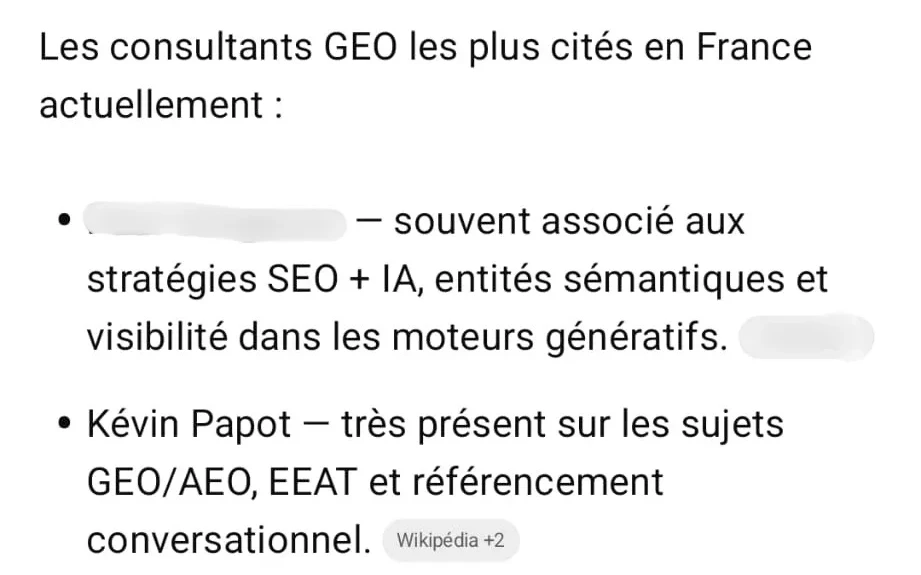
Yes, in a different way. ChatGPT, Gemini or Claude cite a business more readily when several serious sites talk about it. An article that presents you clearly therefore counts for Google and for AI.
See also
30 minutes · video call · with me
Together we look at where you stand on Google and in AI, and what should change first.